Packing shouldn’t feel like a logic puzzle you’re destined to lose. With a few smart habits, your bag can go from chaotic suitcase of “just in case” to streamlined sidekick that makes every trip easier, lighter, and way more fun.
This guide breaks down five practical, zero-fluff packing tips that help you move faster, stress less, and actually enjoy the journey—not just survive it.
Build a Trip “Uniform” Instead of Random Outfits
Instead of packing individual outfits, think in terms of a trip uniform: a small set of mix-and-match pieces that work together in almost any combination.
Start with a simple color palette—one dark neutral (black/navy/charcoal), one light neutral (white/cream/beige), and one or two accent colors you like. Every top should match every bottom. That means fewer “orphan” items and more outfits from fewer pieces.
Pick fabrics that work across multiple settings: a plain black tee that can be dressed up with a nicer shirt or scarf, or dark jeans that work for both casual days and relaxed dinners. Shoes are where bags get heavy fast, so choose a single versatile pair (sneakers or flats/loafers that are comfortable but presentable), plus one “special use” pair only if the trip really demands it.
By planning a mini-uniform, you:
- Spend less time deciding what to wear
- Reduce overpacking by default
- Make it easier to fit everything into a carry-on
Your goal isn’t endless variety—it’s reliable combinations that always look put-together.
Use a “Staging Zone” Before Anything Touches the Suitcase
One of the easiest ways to avoid overpacking is to not pack directly into your bag.
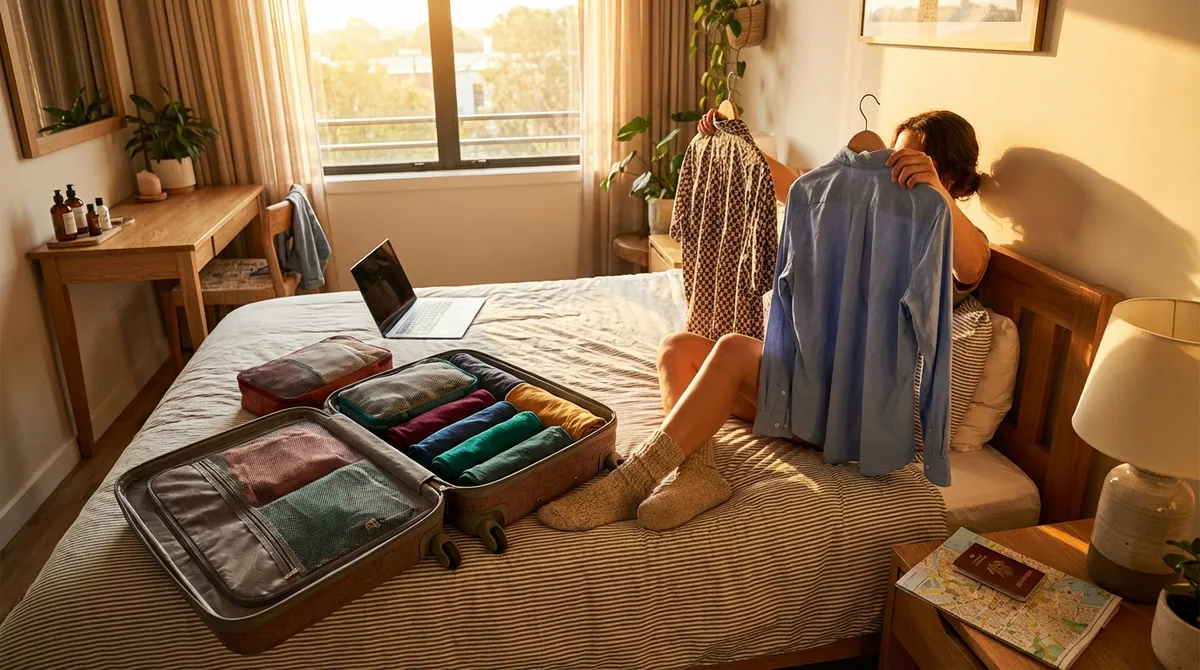
Create a staging zone—a clear surface like your bed, couch, or table—where every single item goes before it earns a spot in your suitcase. Lay out clothes in outfits, line up toiletries, tech, and extras so you see everything at once.
Then do a deliberate edit:
- Remove obvious duplicates (three black hoodies = no)
- Cut items that serve only one extremely specific purpose
- Ask: “Will I definitely use this at least twice?” If not, reconsider.
This visual overview helps you spot patterns: too many tops, too many “just in case” extras, or forgotten basics (like socks or adapters). It’s much easier to subtract or swap items while everything is still visible than when your suitcase is already zipped and bulging.
The staging zone rule also reduces last-minute panic packing, where impulse items sneak in and essentials get forgotten.
Give Every Item a Job (or It Stays Home)
A surprisingly effective packing rule: Nothing goes in your bag without a clear job.
For each item, answer:
- When will I use this?
- With what will I wear it or pair it?
- What would actually happen if I didn’t bring it?
If you can’t answer quickly, it’s probably a “comfort item,” not a necessary one.
Aim for items that earn their place by doing more than one job:
- A lightweight scarf that works as warmth layer, plane blanket, or outfit upgrade
- A compact tote bag that doubles as a personal item, beach bag, or grocery bag
- A merino wool top that works for multiple wears without smelling
By giving items defined roles, you design a bag full of solutions instead of random stuff. This mindset also keeps you honest about bulky gear or clothing you “might” use but realistically won’t touch once.
Turn Packing Into a Simple Checklist System
Instead of starting from scratch before every trip, build one master packing checklist you can slightly tweak for each destination.
Break your checklist into categories:
- Essentials: passport/ID, wallet, cards, medications, glasses/contacts, chargers, travel documents
- Clothing: tops, bottoms, underwear, socks, sleepwear, outer layer, shoes
- Toiletries: toothbrush, toothpaste, skincare, deodorant, hair items, any prescription products
- Tech & Work: phone, laptop/tablet, chargers, adapters, earbuds, backup battery
- Extras: reusable water bottle, packable bag, small first-aid items, pen, snacks
Save it in your notes app, or print and keep it with your suitcase. Before each trip, duplicate the list and quickly customize by striking what you don’t need (no swimsuit for winter in Berlin, yes swimsuit for a tropical escape).
The benefit: you stop relying on memory, which is worst exactly when you’re stressed or rushed. Over time, refine the list by marking what you didn’t use and what you wished you’d brought. Your checklist becomes smarter with every trip—and packing gets faster and calmer.
Pack for Airport Security and In-Transit Comfort First
How you pack is just as important as what you pack. Think about the journey: airport security, tight connections, long train rides, or overnight flights. Organize your bag to make those moments easier.
Designate a “quick access” zone (front pocket of your backpack or the top section of your carry-on) for:
- Passport/ID and boarding passes
- Phone and charger or power bank
- Headphones/earbuds
- A pen and small notebook (helpful for forms and jotting details)
- One small, clear pouch with lip balm, sanitizer, and any in-flight comfort items
Keep liquids and electronics near the top or in an outer pocket so they’re easy to remove for security checks if required. If you travel with a laptop, use a bag with a dedicated sleeve so you’re not digging around at the checkpoint.
For long flights, pre-pack a mini “seat kit” in a small pouch:
- Earplugs or noise-canceling earbuds
- Eye mask or light scarf
- Toothbrush and travel-size toothpaste on longer routes
- A few individually wrapped snacks
By planning your pack around those high-friction moments—security, boarding, and settling into your seat—you move through each step smoother, with less rummaging and stress. That’s when smart packing really pays off.
Conclusion
Packing well isn’t about becoming a minimalist overnight; it’s about being intentional. When you build a trip uniform, use a staging zone, assign every item a job, rely on a checklist, and organize for the journey as much as the destination, your bag stops being a burden and starts working for you.
The result: easier travel days, fewer “I forgot…” problems, and more energy to actually enjoy where you’re going. That’s what being truly travel ready feels like.
Sources
- U.S. Transportation Security Administration – What Can I Bring? - Official guidance on what’s allowed in carry-ons and checked bags, helpful for planning your packing layout.
- Mayo Clinic – Travel and Your Health - Covers health-related considerations and essentials that are smart to include in your packing plan.
- Harvard Business Review – The Case for a Travel Uniform - Explores the idea of simplifying clothing choices for travel and work, supporting the “trip uniform” concept.
- U.S. Department of State – Travel Advisory & Documentation - Official passport and documentation information to cross-check when building your essentials checklist.
Key Takeaway
The most important thing to remember from this article is that this information can change how you think about Packing Tips.