Travel doesn’t have to feel like a logistical puzzle every time you leave home. With a few clever systems, you can turn stressful “hope it works out” trips into smooth, almost automatic adventures. The best part? These tricks don’t require fancy gear or elite status—just a bit of planning and a willingness to tweak your routine.
Below are five practical, field-tested hacks that help you save time, money, and energy—so you can focus on actually enjoying your trip.
Turn Your Phone Into a “Travel Control Center” Before You Leave
Your phone can either be a distraction machine or your most powerful travel tool. Set it up before you go so it quietly handles the boring stuff in the background.
First, create a dedicated “Travel” folder on your home screen with essentials: airline app, maps, translation app, hotel booking app, note-taking app, and a currency converter. Download offline maps for your destination in Google Maps or Apple Maps so you’re never stuck when Wi‑Fi disappears. Add key locations—your hotel, airport, train stations, and one or two hospitals or clinics—as saved places for one-tap navigation.
Next, store digital copies of your passport, ID, travel insurance, and reservations in a secure notes app or encrypted cloud folder. If your documents get lost or stolen, having backups speeds up replacements and border crossings. Turn on alerts for flight changes in your airline app, and add all flights, check-in times, and booking codes to your calendar with notifications.
Finally, prep for language and money: download an offline translation pack in Google Translate and an offline currency conversion app. This tiny bit of setup makes you less dependent on roaming data and more confident the second you land.
Use the “First and Last Hour” Method to Avoid Arrival Chaos
Most travel stress hits in two moments: right when you arrive and right before you leave. A simple planning trick—protecting your first and last hour in each location—can dramatically shrink that anxiety.
Before your trip, script your first hour on arrival like a mini playbook. How will you get from the airport or station to your accommodation? Where’s the nearest ATM or metro stop? Are you buying a local SIM, using eSIM, or relying on Wi‑Fi? Write this out in a note and screenshot it so it’s accessible even offline.
Do the same for your last hour before departure. What time do you need to leave your accommodation to arrive at the airport or station with a buffer? Where’s your boarding pass stored? What’s your plan if your usual transport option (like Uber) falls through—do you know a backup bus line or taxi stand?
By deciding these details ahead of time, you turn vague “I hope this works” stress into a clear mini-mission. That structure makes you calmer, less rushed, and way less likely to forget something critical in the shuffle.
Build One Reusable “Home Base” Kit and Drop It Into Every Bag
Instead of reorganizing your life every time you pack, create a small, permanent “home base” kit that moves from trip to trip. This kit holds the everyday items that instantly make any room feel functional and familiar.
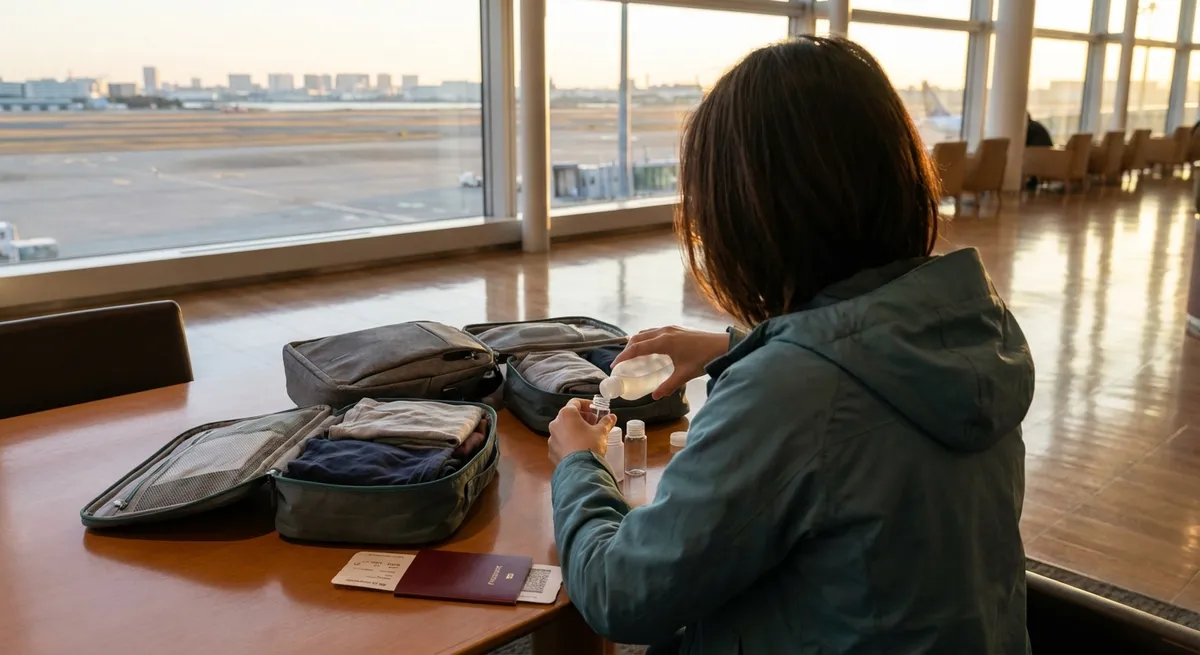
Use a compact pouch and stock it with multi-use basics: a small power strip or travel adapter with multiple USB ports, a short extension cord if you travel often, a microfiber cloth (for glasses, screens, and quick cleanups), a foldable tote bag, a pen, and a tiny roll of tape or a few binder clips (for broken zippers, curtains that won’t close, or makeshift cord organizers). Add a few comfort items like herbal tea bags, pain relievers, and bandages or blister patches.
The rule: this kit never fully unpacks at home. After a trip, you restock it and store it inside your main carry-on or suitcase. That way, when it’s time to travel again, a big chunk of your prep is already done. Every new hotel, guesthouse, or rental instantly feels more “yours” because your core tools are right there.
Book With a “Two-Column” Strategy to Protect Your Budget and Flexibility
Random booking choices add up to surprise costs. A simple two-column strategy—fixed vs. flexible—helps you keep control without overplanning your entire trip.
In the fixed column, put bookings that truly need to be locked in: long-haul flights, a can’t-miss event, or accommodations during a festival or peak season. These are the reservations where paying a bit more for reliability or location can be worth it, especially when prices tend to spike closer to the date.
In the flexible column, put things that are easier to change: day trips, internal transport options, museum tickets with multiple entry times, or secondary hotels. For these, prioritize free cancellation windows, refundable options when the price difference is small, or paying on arrival. This lets you adjust your plans if weather shifts, you fall in love with a place and want to stay longer, or you find a cheaper route after booking.
Before hitting “book” on anything, ask: “Does this belong in my fixed or flexible column?” That simple question keeps you from locking in too much too early—or leaving everything to last minute panic.
Design a Simple “Security Routine” You Can Repeat Anywhere
You don’t need to be paranoid to be prepared. A repeatable, low-effort security routine can protect your documents, money, and data without turning your trip into a spy movie.
First, decide on a “home spot” in every room for your essentials—usually a flat, visible surface near the bed. This is where your passport, wallet, phone, and room key live every time you’re inside. If one thing is missing from that spot, you notice it quickly instead of realizing it at the airport.
Next, split your funds: keep a main card and some cash in your wallet, and a backup card plus emergency cash in a separate place (like a hidden pouch in your luggage or a money belt you don’t access in public). Take photos of your cards’ front and back and store them securely so you can quickly freeze or replace them if needed.
For digital safety, avoid logging into sensitive accounts on random public Wi‑Fi. Use your phone’s hotspot when possible, or a reputable VPN if you’ll be working, banking, or handling private info. Turn on device tracking (like “Find My” on Apple or similar services on Android), and enable a screen lock if you haven’t already.
When security becomes a simple routine rather than a vague worry, you spend less energy thinking, “What if something goes wrong?” and more enjoying where you are.
Conclusion
Travel feels a lot lighter when you shift from “reacting to problems” to quietly preventing them. Turning your phone into a travel control center, scripting your first and last hour, using a reusable home base kit, booking with a fixed vs. flexible mindset, and following a simple security routine are small moves with huge ripple effects.
Pick just one of these hacks to try on your next trip. Once it becomes second nature, layer in another. Over time, you’ll build your own set of stealth-smart habits that make every journey smoother—and a lot more fun.
Sources
- U.S. Department of State – Travel Preparation Guidance - Official advice on documents, safety, and general trip readiness
- Transportation Security Administration (TSA) – Travel Tips - Practical guidance for airport screening, packing, and security routines
- Centers for Disease Control and Prevention (CDC) – Traveler’s Health - Health-related planning, destination advisories, and recommended preparations
- Google Support – Use Google Maps Offline - Step-by-step instructions for saving maps for offline navigation
- Federal Trade Commission (FTC) – Online Security Tips - Best practices for protecting your personal and financial data while using the internet
Key Takeaway
The most important thing to remember from this article is that this information can change how you think about Travel Hacks.